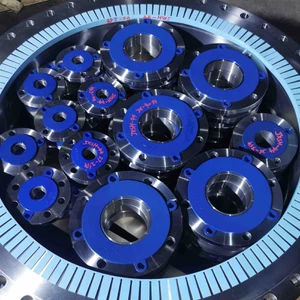
The Manufacturing Difference Between ASME B16.5 Flange Second and Third Forging
ASME B16.5 is a general American industry standard and is one of the most commonly used standards in the field of piping and valve fittings. In ASME B16.5, the grades of flanges are divided into 150, 300, 400, 600, 900, 1500 and 2500, and there are also different requirements on the forging mode of flanges. This paper will compare and analyze the third and second forging of flange in ASME B16.5 standard.
Flange forging is divided into three forging and two forging. In flange forging, the hammer forging process is used to compress and deform the material of the flange, so that it can achieve a tighter and denser effect, and improve the strength and durability of the flange.
Flange grades 300 and below in ASME B16.5 require the use of secondary forging, while grades 400 and above require the use of tertiary forging. This is because higher grade flanges can withstand more pressure and weight, requiring higher strength steel, and three stage forging can improve the strength and durability of steel, making it more suitable for the manufacture of higher grade flanges.
The main difference between three forging and two forging lies in the different forging process and conditions. The hammer used in the two-stage forging is relatively small, the hammer frequency is high, and the forging is carried out at a low temperature and strength. In the third stage forging, the hammer head is larger, the hammer frequency is lower, and the forging is carried out under the condition of higher temperature and greater strength. As a result, the steel produced by three-stage forging is denser and has higher strength and durability.
In general, the grades of flanges in ASME B16.5 require different forging methods depending on the pressure they are subjected to. Secondary forging is suitable for lower grade flanges, while tertiary forging is suitable for higher grade flanges. By using proper forging process and materials, can ensure that the flange in use can play a better performance, improve its safety and reliability.